“Reorg” Impacts on Collaboration
GOAL | To understand the impact on employee collaboration after a significant reorganization (i.e., “reorg”) or the sales department.
RESULTS | Initially, the reorg harmed employee and manager interactions and work-life balance. It also increased the frequency and length of meetings.
RECOMMENDATION | Sales leadership to survey employees that had no 1-on-1 meetings with managers and were spending substantial time in discussions since the reorganization.
How did the reorg affect collaboration overall?
*For comparison reasons, collaboration data between November 2020 and December 2020 were excluded from the analysis due to multiple holidays.
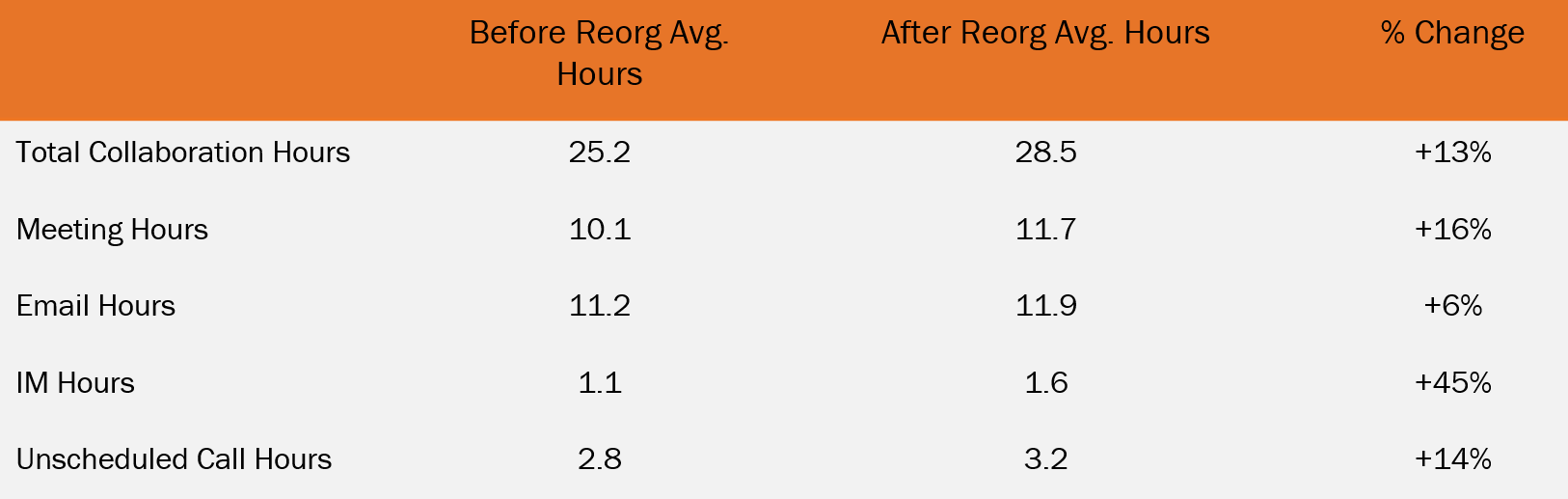
All aspects of collaboration increased after the reorg, including actual collaboration hours, meetings, emails, IMs, and unscheduled calls. IM hours had the most significant percentage increase (+45%), while email hours increased by the least (+6%). Logically, this makes sense as a “reorg” would require more communication between team members.
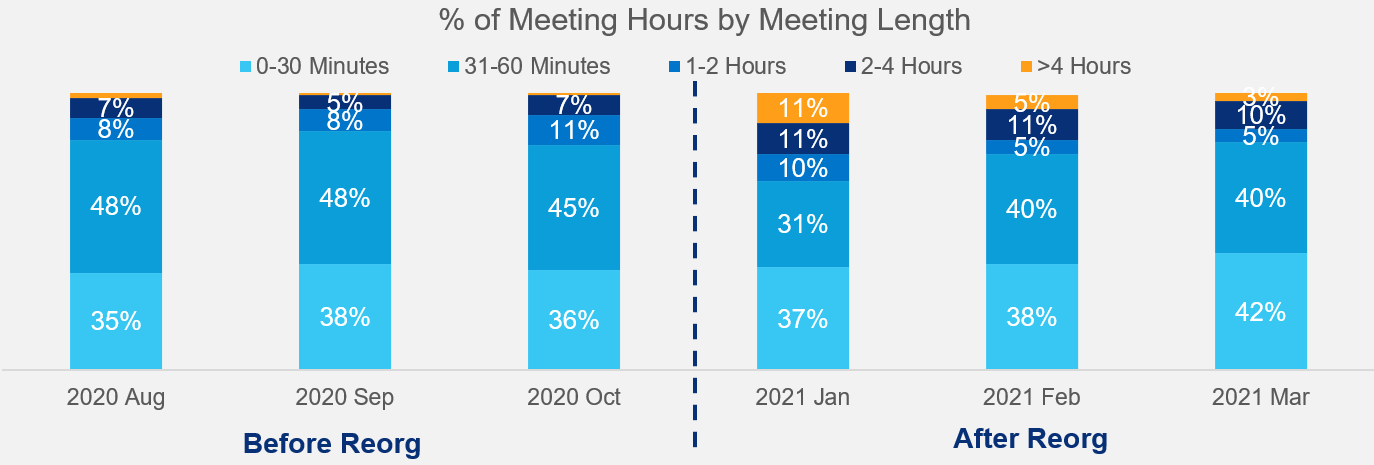
In fact, before the reorg, 14-20% of all meetings between August 2020 and October 2020 lasted more than an hour long. After the reorg, this increased to 32% - with 11% being meetings that lasted longer than four hours. However, by March 2021, meetings that lasted more than an hour were at 18%, which is in line with meeting hour lengths before the reorg.
Did the reorg impact employee-manager relationships?
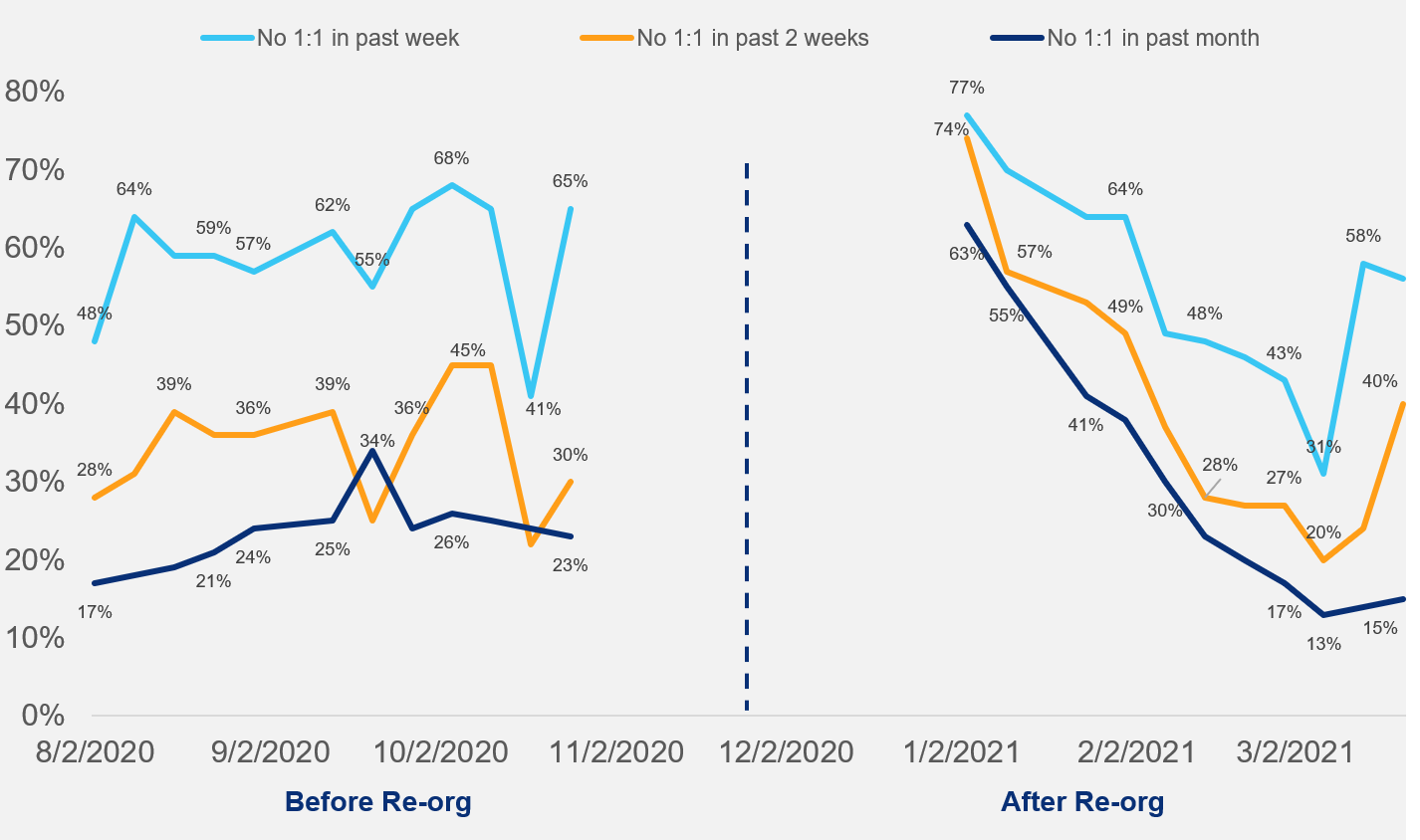
In October 2020, 65% of sales employees did not have weekly 1-on-1s with their manager before the reorg. However, this metric increased by 12% in January after the reorg! The hypothesis is that managers and employees were busier than usual adjusting to the new system and thus did not have time for weekly 1-on-1s.
Eventually, more 1-on-1 meetings started to occur as only 56% of employees were not having weekly 1-on-1 meetings with their manager by March 2021 (a 9% decrease from October 2020).
If meeting duration increased, did the number of attendees increase, as well?
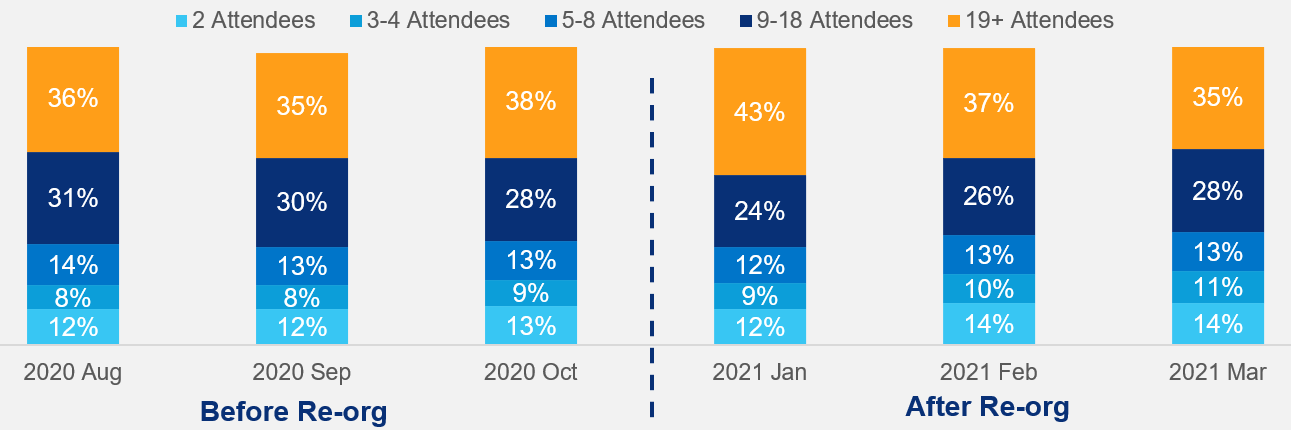
While 1-on-1 meetings decreased at the onset of the reorg, larger meetings increased. Meetings with 19+ attendees accounted for an additional 5% of meetings from October 2020 to January 2021 (38% to 43%).
The increase is directly attributed to sales employees' requirement to participate in large training meetings to get up to speed on the hierarchy and responsibilities of new roles.
The percentage of meetings with 19+ attendees slowly decreased from 43% in January to 35% in March 2021 - basically at pre-reorg levels.
Let's now look at the meeting size metric drilled down to the new roles (labeled with a "CS" in front of the title). The graph below depicts the total meeting hours by meeting size between January 2021 and March 2021. We can see that CS Support Reps spent a substantial
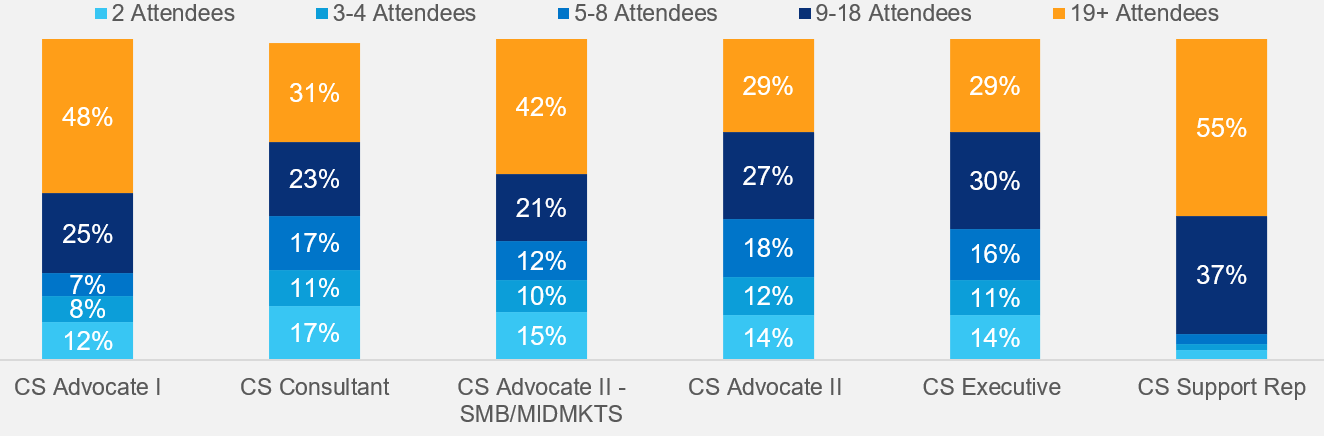
amount of meeting hours, more than half, in meetings with 19+ attendees. Additionally, 92% of their total meeting hours have at least nine attendees in the meeting! The hypothesis is that support reps required more training than their peers. Still, HR leadership was surprised to know that it was over 50% of their total meeting time. Similarly, CS Advocates spent 56-73% of their total meeting hours in meetings with at least nine attendees.
Next Steps
The conclusion was to get feedback from CS advocates and support reps if they found these large meetings productive. HR leadership also wanted to continue to monitor the percentage of time that these roles spent in large meetings. Basically, if the trend was steady, increased, or decreased over time. HR leadership also wanted to ensure that employees were having weekly 1-on-1 with their managers and to survey those who had not had 1-on-1 with their managers since the reorg.